The Packing Trick That Fits Your Week's Laundry Into Two Bags
Your suitcase is full but the zipper is pinched. A compression bag pulls the air out of the puffy layers and gives you the space back, so the week's clothes, the chargers, and the snacks all fit. Here is the packing order that keeps it flat.
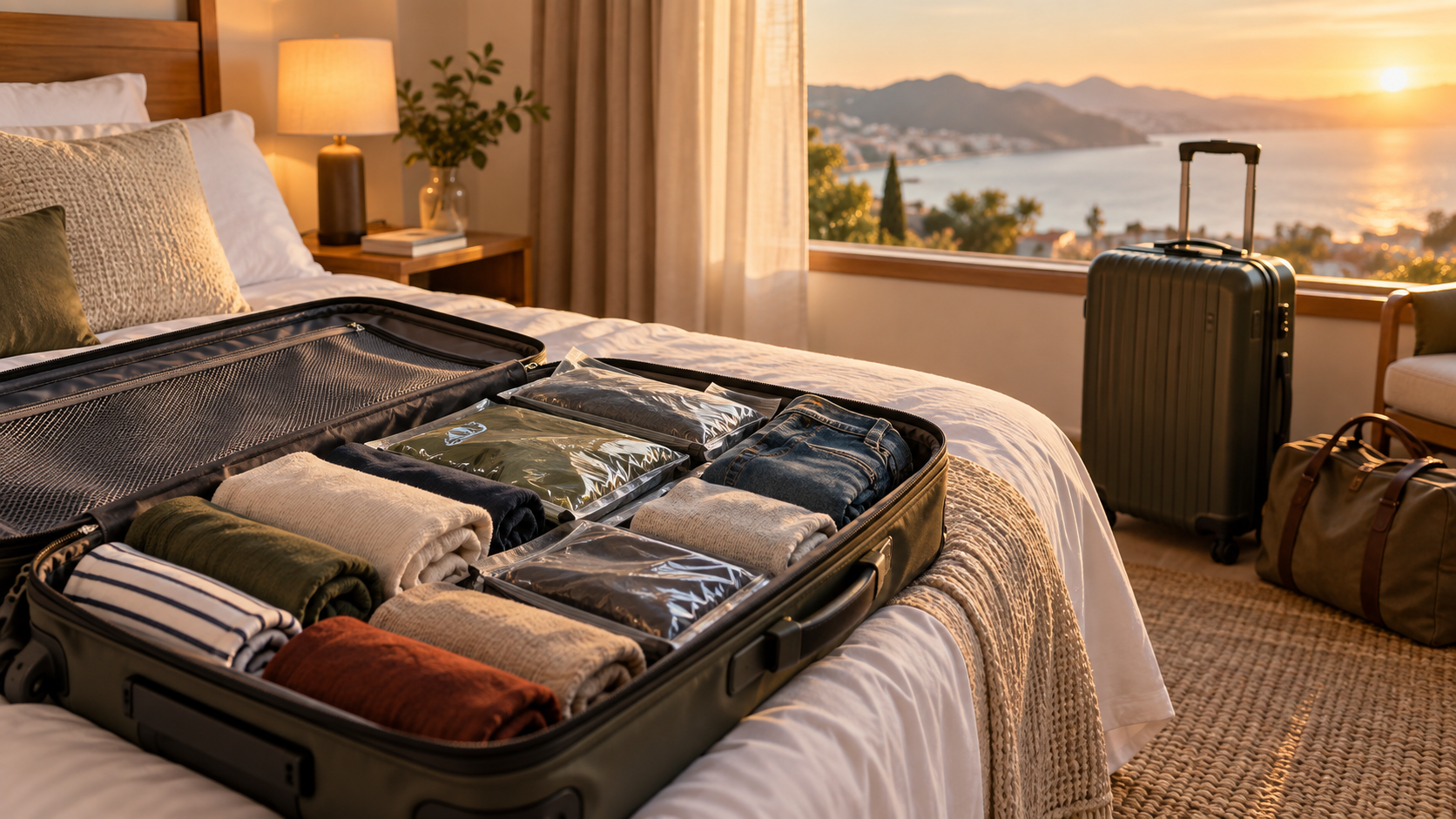
It happens every single time. You packed for four days, but you packed like you were moving apartments. The suitcase is full, the zipper is pinched, and you have not even started the drive yet. I have sat on the floor of a hotel room with half my clothes folded and the other half on top of them, doing math like a person trying to park a truck in a spot that fits a bike.
The fix is not a bigger suitcase. It is a compression bag, the kind that actually removes the air instead of just squeezing it around. Once you use one, the way you used to pack starts to feel a little embarrassing, in the best way. It is the difference between "let us hope the zipper holds" and zipping it shut with your hand while the rest of the trip waits in the other room.
Why a compression bag works when folding does not
Folding is a lie we tell ourselves. A folded hoodie still holds a lot of air inside it, because the fabric is soft and puffy and refuses to sit still. A compression bag changes the whole deal. You slide your clothes in, seal the valve, pump the air out, and the bag shrinks down to the size of a flat brick. No, a thin rectangle. Your clothes are still in there, they are just no longer holding onto a pocket of air the way a pillow does.
There are two kinds on the market, and the difference is how you get the air out. The first kind uses a hand pump or a roll-and-seal motion, where you roll the bag and press a valve down to squeeze the air out. The second kind is cordless, with a small built-in vacuum you switch on, and it pulls the air out in about twenty seconds. If you have tried the roll-and-seal kind on a thick down jacket, you know exactly why the cordless version exists. It is the difference between a ten second task and a three minute negotiation with a piece of plastic.
Here is the part that matters for a buyer: the bag itself is the simple part. The seal is the whole job. If the zipper does not stay shut under pressure, the air comes right back. Most of the better sets use a two-way zipper that locks, and a plastic valve that clicks when it is sealed. If your bag hisses for a day and then slowly puffs back up, that is the valve, not your luck.
What to put in the bag and what to leave out
Not everything wants to go in a compression bag. The things that compress the most are the things that are mostly air: hoodies, sweatshirts, puffy jackets, sweaters, and fleece. A down jacket that took up half your suitcase on the way to the bathroom door can shrink down to the size of a paperback. That is where the magic is, and it is why these bags save you on the exact trips where you packed the warm layers because the forecast said maybe.
The things that do not gain much are the dense ones. Jeans, shirts, and structured items are already pretty solid, so squeezing them saves you an inch at best. You can still put them in, but do not expect a miracle. And there are a few you should skip entirely: anything that wrinkles for its soul, like a button-down you are actually going to wear, and anything with a hard shell. If you are flying with a blazer or a pair of nice trousers, roll them and let them breathe. If you stuff a suit into a vacuum bag and pull it out tomorrow, you are going to be ironing in a hotel bathroom with a towel for a hanger.
One rule that keeps people from ruining a good outfit: keep the compression bags for the bulky layer, and use a soft pouch or a garment bag for the outfit you are presenting to the world. The bag is a strength tool, not a wrinkle factory.
If you pack for a week or a road trip, the cordless sets are the honest recommendation. You do not want to be standing over a suitcase at 6 a.m. with a hand pump and a full cup of coffee you cannot set down. The cordless version pulls the air out in a few seconds, you close the valve, and you are done before the coffee goes warm. If you only travel lightly a few times a year, the roll-and-seal bags are fine and cost less. Both do the job. The cordless one just does it without making you work for it.
A set like the cordless compression bag set is the kind of thing that stays in a closet for a long time, because you keep finding uses for it. It does more work than clothes. It is for the extra pillows at the cabin, the bulky toys after a long car ride, and the pile of laundry that somehow came home heavier than it left.
Traveling with more than clothes
Compression bags are a closet trick, but the bigger win is what they free up in your main bag. Once your layers stop eating half the suitcase, you get space back for the stuff you actually forgot to pack: the charger, the book, the good snacks for the drive, the extra pair of shoes you are already dreading. That reclaimed space is the whole point. You are not shrinking your trip, you are shrinking the part of the trip that fights you.
If your trip is gear-heavy, a hard case is worth its own conversation. Soft bags compress, but they do not protect. For a camera body, a game console, or anything with a screen, you want a case that keeps its shape when the luggage cart treats it like a football. The hard-shell case is the one for that job. It does not compress, it just does not crush, and the foam inside holds each item in its own pocket. Think of it as the difference between a backpack and a briefcase. One is flexible and forgiving, the other is structured and protective, and your expensive electronics are the kind of thing that wants the briefcase treatment.
For shoes and the outfit you will wear through the airport, a duffle with a dedicated compartment keeps wet or dirty gear away from the clean stuff. The travel duffle is the kind of bag that does not care if you toss a pair of boots in one end and a change of clothes in the other. It is the opposite of the compression bag: no sucking air out, just a lot of room and a place for everything. When you are back home and the suitcase needs a quick dump, this is the bag that makes the floor mess manageable.
The packing order that actually works
Once you have the bags, the order you pack in is half the battle. Here is the sequence that keeps the bag flat and the zipper easy:
- Heavy and dense items on the wheel side, so the bag rolls on its flat edge instead of tipping.
- Compress the bulky layers into their bags first, while they are still loose and easy to fit.
- Flat items, like shoes and belts, along the edges where they fill the gaps.
- The outfit you will wear, rolled and kept at the very top, so it stays wrinkle-free and easy to reach.
The compression bags fit into that order naturally. They go in the middle, because they are the most forgiving, and once they are packed flat they hold the rest of the load steady. You are building a wall, not a pile.
A few mistakes keep people from getting the full benefit, and they are all easy to fix. Overfilling the bag is the big one. A compression bag needs a little room to work, and if you cram it until it bulges, the air has nowhere to go and the bag never seals flat. Leave a hand of space. The second mistake is sealing the bag before you take out the air, which means you are zipping the bag shut with all the air still inside. And the third is reusing a bag that has a slow leak. If it does not hold for a day, it is done, and it costs a few dollars to replace. Do not spend a whole trip fighting a dying seal.
When you do not need one at all
If you travel with just a carry-on and light clothes, a compression bag can be overkill. You may not need it, and that is a fine place to be. But the trips where it earns its keep are the ones with warm weather, a week of laundry, or a return flight where you are bringing home a souvenir that somehow took up the entire overhead bin. Keep a set in a drawer, and the next time the suitcase fights you, you already own the solution.
Quick answers
Do compression bags damage clothes?
Not if you keep them out of the delicate ones. Dense and structured items are fine, and the puffy layers that benefit the most are also the least likely to care about a little compression. The ones to protect are the items that wrinkle easily, and those are the ones you should roll instead of vacuum.
How many bags do I need?
Start with two or three of the larger size for a family or a long trip, and one smaller one for the quick stuff. If you are traveling light, one medium bag is enough to get the point. You can always add more later, and the sets are cheap enough that it is not a big decision.
Will it work for a carry-on?
Yes, and this is where it shines. The whole problem with a carry-on is that you have less room than you think, and the compression bag is the one tool that gives you room back without making the bag bigger. It is the difference between a bag that just fits and one that has room for the snacks.