
Two Seats, One Big Toy: What to Check Before Buying a Kids' Ride-On Car
Two children, one driveway, and a ride-on truck that needs a place to live afterward. Here is how to check the fit, speed, battery routine, and shared-seat details before choosing the Outfunny 24V two-seater.
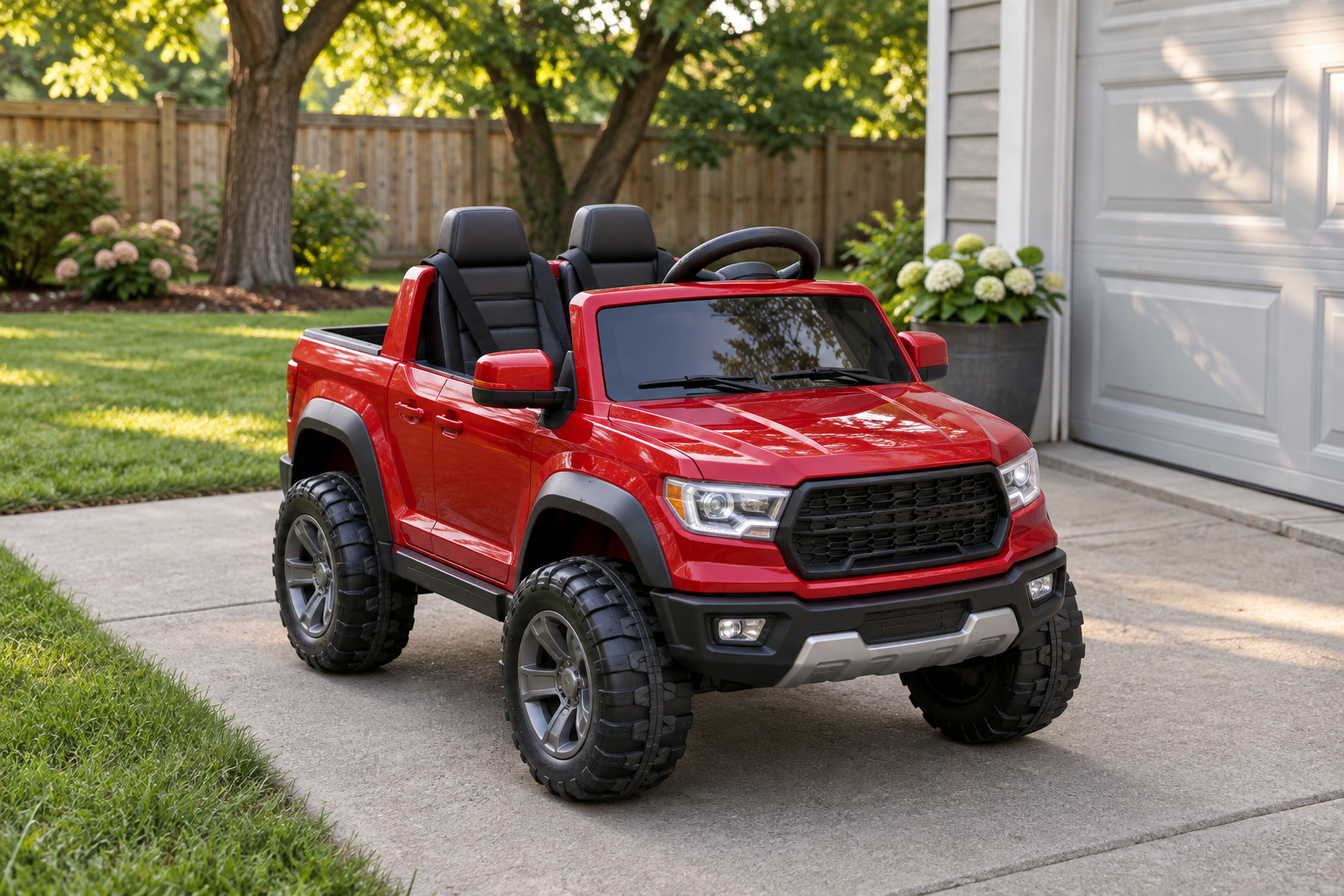
One child spots a ride-on car and immediately makes room for a sibling. The grown-up, meanwhile, is measuring the garage and wondering where the charger will go. Both are asking the right questions. A two-seat electric car can turn a short backyard lap into shared play, but it also asks for space, supervision, and a little planning before the first drive.
The Outfunny 24V two-seater is listed with two 200W motors, a 24V battery, a claimed one-hour run time per charge, 20-inch seats, a 110-pound maximum load, a remote control, Bluetooth, LED lights, and speeds from 3.1 to 4.5 mph. Those numbers help describe the listing, but they do not answer the most important question: does this particular toy suit your children and the place they will use it?
Start with the place, not the product photo
A product image can make a ride-on look smaller than it feels when it arrives. Before you order, measure the route where the children will drive, not only the spot where you might store it. Check doorways, gates, tight turns, and the distance between the play area and the charging spot. If the car needs to travel through a narrow side gate, its overall width matters more than its cheerful headlights.
Think about the surface, too. A smooth driveway is different from uneven lawn, gravel, or a path with roots. The listing describes the car as suitable for grass and gravel, but real yards vary. A soft, bumpy lawn can make a small vehicle work harder than a firm, level patch. Start with the easiest safe area you have, and keep the route away from traffic, steep slopes, water, and places where an adult cannot stay close.
Then solve the storage question. This is a substantial toy, not a ball that can disappear under a bed. Decide whether it will live in a garage, shed, or covered area, and leave room for the charger and any small accessories. If the only available space is already full of bikes, bins, and a mower, the car may become the newest obstacle in the household obstacle course.
Measure the children against the listing
The Outfunny listing describes two 20-inch seats and a total maximum load of 110 pounds. Treat those as starting points for a fit check, not a guarantee that every pair of children will sit comfortably. Two children may fit by the number on the page and still find the seat cramped once coats, elbows, and enthusiastic steering enter the picture.
Look for the maker's age guidance, seat dimensions, restraint details, and instructions in the full listing and manual. Compare them with the children who will actually ride. If the children are different sizes, consider who will sit where and whether each can get in and out without awkward climbing. A quick conversation now is easier than refereeing a seat dispute later.
Also think about how the toy will be shared. Does one child tend to grab the controls? Can the other sit comfortably without leaning over the driver? A two-seater creates room for company, but it does not automatically create turn-taking skills. Simple house rules help: an adult chooses the route, the driver keeps hands on the controls, and riders pause when asked. The fun part tends to last longer when everyone knows the routine.
Understand the speed and the remote
The listing gives a speed range of 3.1 to 4.5 mph and includes a remote control. That is useful information, but read the instructions to learn exactly how the speed settings and remote work on this model. Do not assume a remote has a particular override, braking, or range feature unless the maker spells it out.
Before letting a child drive, practice the controls in an open, flat area with an adult nearby. Show how to start, stop, and steer, then let the child try at the lowest setting described by the manual. Keep the first outing short. A child who is confident walking may still need time to coordinate steering and stopping from a seat, especially when another child is along for the ride.
Set a clear boundary for where the car can go. A driveway that slopes toward the street is not a practice course, and a crowded patio leaves little room to react. An adult should remain close enough to intervene and should follow the product's instructions for supervision. If a child is tired, frustrated, or more interested in the horn than the path, park the car and try again another time.
Plan for the battery routine
The product description claims about one hour of driving per charge. Actual run time can depend on the surface, load, driving style, and other conditions, so treat that as a listing estimate rather than a promise for every trip. A grass route with two riders may feel different from a short run on a smooth surface.
Check the manual for charging time, the correct charger, storage instructions, and what to do before the first use. Charge where the adult can keep an eye on the process, and use only the supplied or maker-approved equipment. Keep charging cables out of the driving path and away from curious hands. When the ride is over, park the car where it can be reached without dragging it across the house or leaving it in the rain.
It can help to make charging part of the play routine: drive, park, plug in as the manual directs, and put the remote and accessories in one known spot. That avoids the classic sequel, which is a fully charged toy and a missing remote.
Separate the fun features from the essentials
Bluetooth and LED lights add appeal, but they are extras. First make sure the basic fit works: the children can sit as intended, the car can use the available route, an adult understands the controls, and storage is realistic. If those pieces do not fit, bright lights will not fix the problem.
Read the listing carefully for what is included and what is not. Check the assembly requirements, battery and charger details, warranty terms, and the seller's instructions for support. Product pages can change, so save or review the details close to purchase rather than relying on an old screenshot or a friend's memory of a similar model.
If the Outfunny setup matches your space and your children's needs, check the Outfunny 24V two-seater listing for the current product details. Compare the listed specifications with the manual and your own measurements before deciding. The right choice is the one that fits the family routine, not the one with the longest feature list.
A quick pre-drive check
Before each outing, take a moment to check that the route is clear, the car looks intact, and the children are seated as the instructions require. Make sure an adult is ready to supervise, especially while the driver is learning. Keep the ride in the agreed area, stop if the surface or weather makes control difficult, and end the trip before everyone is overtired.
That small routine makes the toy easier to manage and helps the children learn that driving time comes with a few simple responsibilities. If the measuring, charging, and supervision plan all make sense, a two-seater can be a fun shared activity. If one of those pieces is a stretch, it is perfectly reasonable to choose a smaller or simpler toy instead.