
A Bottle Washer Has to Fit Your Counter and Your Routine
A countertop bottle washer can look like one less job after a feeding, but only if it fits the bottles, pump parts, water setup, and drying space you actually have. Here is what to check before considering the Momcozy KleanPal Pro.
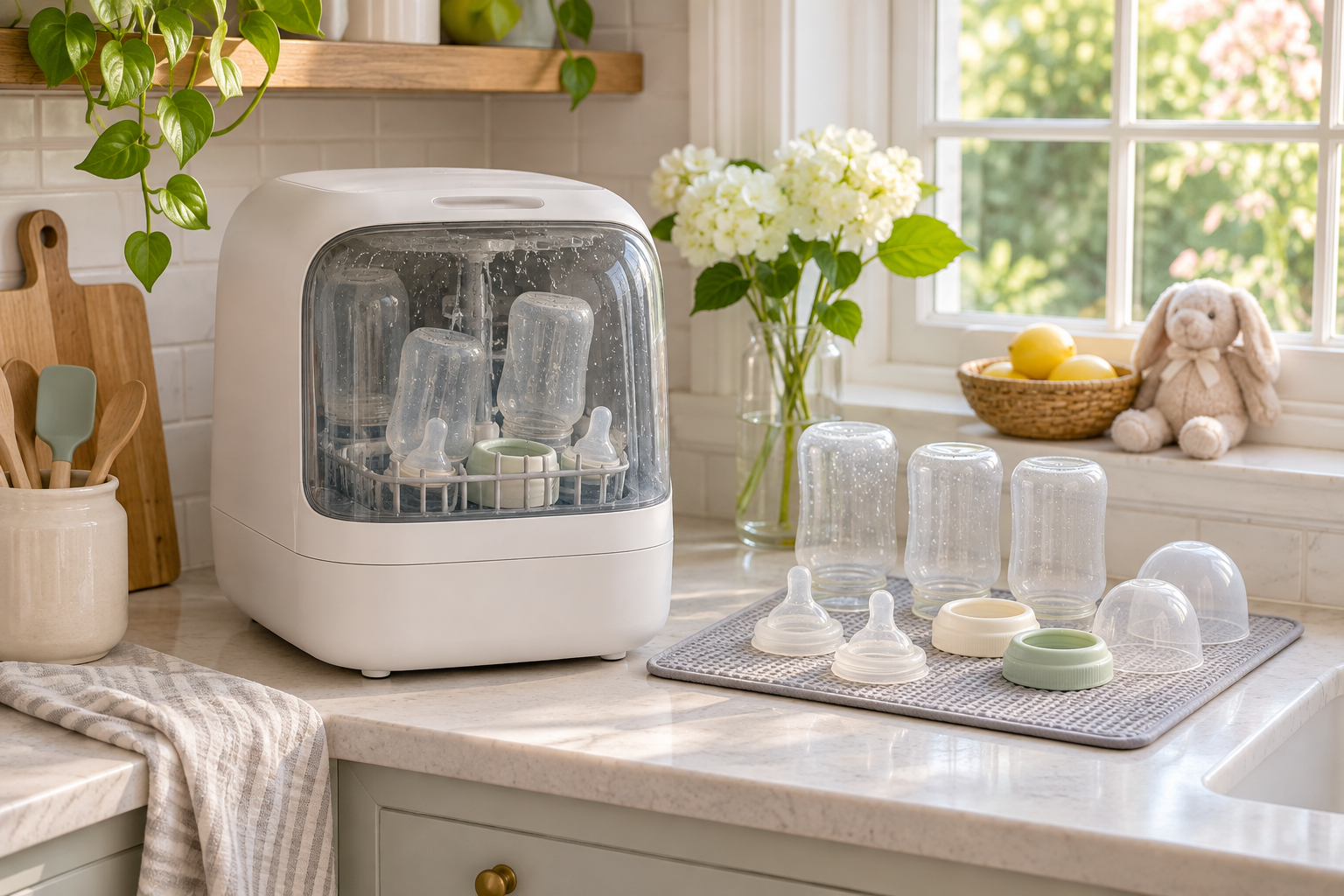
It is late, the last bottle is in the sink, and the tiny valve you need to clean has somehow disappeared under a dish towel. A countertop bottle washer sounds appealing in that moment. Before making room for one, though, it helps to ask a less exciting question: will it work with the things you use every day?
The Momcozy KleanPal Pro is listed as an all-in-one bottle washer, sterilizer, and dryer. Its current product listing describes 26 spray jets, nine cleaning modes, and storage for up to 72 hours. Those are useful details to investigate, but the product name and a feature list cannot tell you whether the machine fits your bottles, your counter, or your household's feeding routine. A little measuring and manual-reading now can prevent a large appliance from becoming an expensive dish rack.
Start with the parts you need to wash
Make a short inventory of what actually goes through the sink in a typical day: bottles, nipples, caps, pump parts, small cups, or other feeding pieces. Then compare that list with the manufacturer's current compatibility guide and loading instructions. Do not assume every part that looks dishwasher-safe or washable can go in this machine. Materials, shapes, and manufacturer instructions differ, and a snug fit in a product photo is not a compatibility guarantee.
Pay special attention to small pieces. A nipple, valve, or connector can be easy to lose and may need a specific position or accessory to stay put during washing. Check whether the listing and manual explain where each piece goes, what the machine includes, and whether any accessory must be purchased separately. If the instructions do not clearly cover a part you rely on, ask the manufacturer before buying rather than testing your luck with a piece that matters.
The KleanPal Pro listing says it can wash bottles, pump parts, and baby tableware. That is a useful starting point, not a promise that every brand, size, or material is suitable. Bring your exact product names into the comparison. If you use a bottle with an unusually wide neck or a pump with several small components, look for specific guidance instead of relying on a broad category label.
Measure the countertop, not the product photo
Choose the place where the washer would live and measure its usable width, depth, and height. Include room for anything that opens, lifts, or needs to be reached during loading. Check the space above it too, especially if an upper cabinet hangs over the counter. A machine may fit between the coffee maker and the wall but leave no comfortable way to open its lid.
Also think about what sits nearby. Does the chosen spot have the water access the manual requires? Is there an outlet in a suitable location? Can you move a hot or wet item without reaching over a burner or balancing it beside the sink? Follow the installation and electrical directions from the manufacturer. If the instructions call for a particular setup, do not improvise a workaround just because the appliance is described as convenient.
Take a photo of the proposed spot and note the measurements before shopping. Then compare those numbers with the full product dimensions, not a cropped image or a vague claim that a machine is compact. Leave yourself enough room to fill, empty, clean, and maintain it. A tight fit can turn a routine task into a small daily wrestling match.
Understand what the spray-jet claims mean
The current listing describes 26 spray jets, including 12 directional jets aimed at bottle interiors and 10 swirling jets for surfaces. That tells you how the seller describes the spray arrangement. It does not establish that every load will come out clean, or that you can skip any preparation the manual calls for.
Read the loading instructions carefully. Find out whether bottles should be rinsed or emptied first, how pieces should face, and whether tightly nested items can block water from reaching them. Ask how much fits in one load and whether the answer changes when you include pump parts. A capacity that sounds generous may feel different when each little component needs its own place.
Cleaning performance also depends on using the machine as directed and keeping it maintained. Look for instructions on cleaning the tank, filter, spray outlets, and any other parts that collect residue. If the manual recommends specific detergent or warns against certain products, follow that advice. Do not substitute a cleaning product based on a guess about what seems gentle or familiar.
Separate washing, sterilizing, drying, and storage
All-in-one labels can blur several different jobs. The listing describes washing, sterilizing, and drying, and says the unit can store items for up to 72 hours. Check the manual for what each mode does, how long it runs, and what conditions apply to the storage claim. Ask whether items must stay inside with the door closed, whether a cycle is required first, or whether any other steps are specified.
Do not treat a product feature as medical advice. Follow the instructions that came with your feeding equipment and ask your pediatrician or another qualified clinician if you have questions about what level of cleaning or sterilizing is appropriate for your situation. Families may have different needs, and a marketing phrase cannot account for an individual child's health or a clinician's guidance.
Drying is worth checking separately too. Find out how the machine handles items that trap water, whether the manual calls for repositioning pieces, and what to do if a part is still damp. A storage claim is most useful when you understand the conditions behind it. If those conditions do not match how you unload and use bottles, the headline number may not change your day much.
Compare the whole routine, not just the cycle
A machine can reduce hand-scrubbing while adding other small jobs: loading parts, refilling or connecting water, emptying a reservoir, cleaning the interior, and making room for the next batch. Write down which of those steps the manual assigns to the owner. Consider who will do them and whether they fit the rhythm of your household.
For example, imagine you pump several times a day and use a mix of bottles and pump pieces. Instead of asking only whether it washes pump parts, ask whether your exact pieces can go in together, whether they fit in one load, and what you must do before and after the cycle. If one tiny component needs a separate wash or the machine is full when you need it again, that changes the value of the purchase.
Households that use only a few bottles may prefer a simple washing setup that takes little counter space. A family with more daily parts may be willing to give up a larger patch of counter if the loading instructions and capacity suit them. Neither choice is automatically better. The useful one is the one you can keep using without adding a new chore you resent.
Check the details before checkout
- Measure the counter, cabinet clearance, and access to the setup the manual requires.
- Confirm compatibility for your exact bottles, pump pieces, and materials.
- Check what is included, how parts are loaded, and whether any accessories are sold separately.
- Read the mode, maintenance, detergent, and storage instructions in the current manual.
- Compare the actual capacity with the number of items you need ready between cycles.
It is also sensible to review the seller's return terms, warranty details, and customer support route before ordering. Those policies can change, so check the current listing and keep the information with your purchase records. If you cannot find an answer to a compatibility or setup question, pause and ask. A product page that leaves a basic question unanswered is a reason to gather more information, not a reason to fill in the blank yourself.
If the dimensions work, your feeding parts are specifically covered by the instructions, and the daily steps sound manageable, the Momcozy KleanPal Pro may be worth comparing with your current washing routine. If one of those checks fails, a smaller setup could be the calmer choice. Either way, the best decision comes from your actual bottles and counter, not from a dramatic product photo taken in a kitchen with suspiciously empty counters.