
A Kitchen Scale Makes Baking Repeatable
A cup of flour is never the same amount twice. Weighing your ingredients is the cheapest way to make a recipe repeatable, and a scale with enough capacity, gram increments, and a display you can actually read under a big bowl is the one to buy.
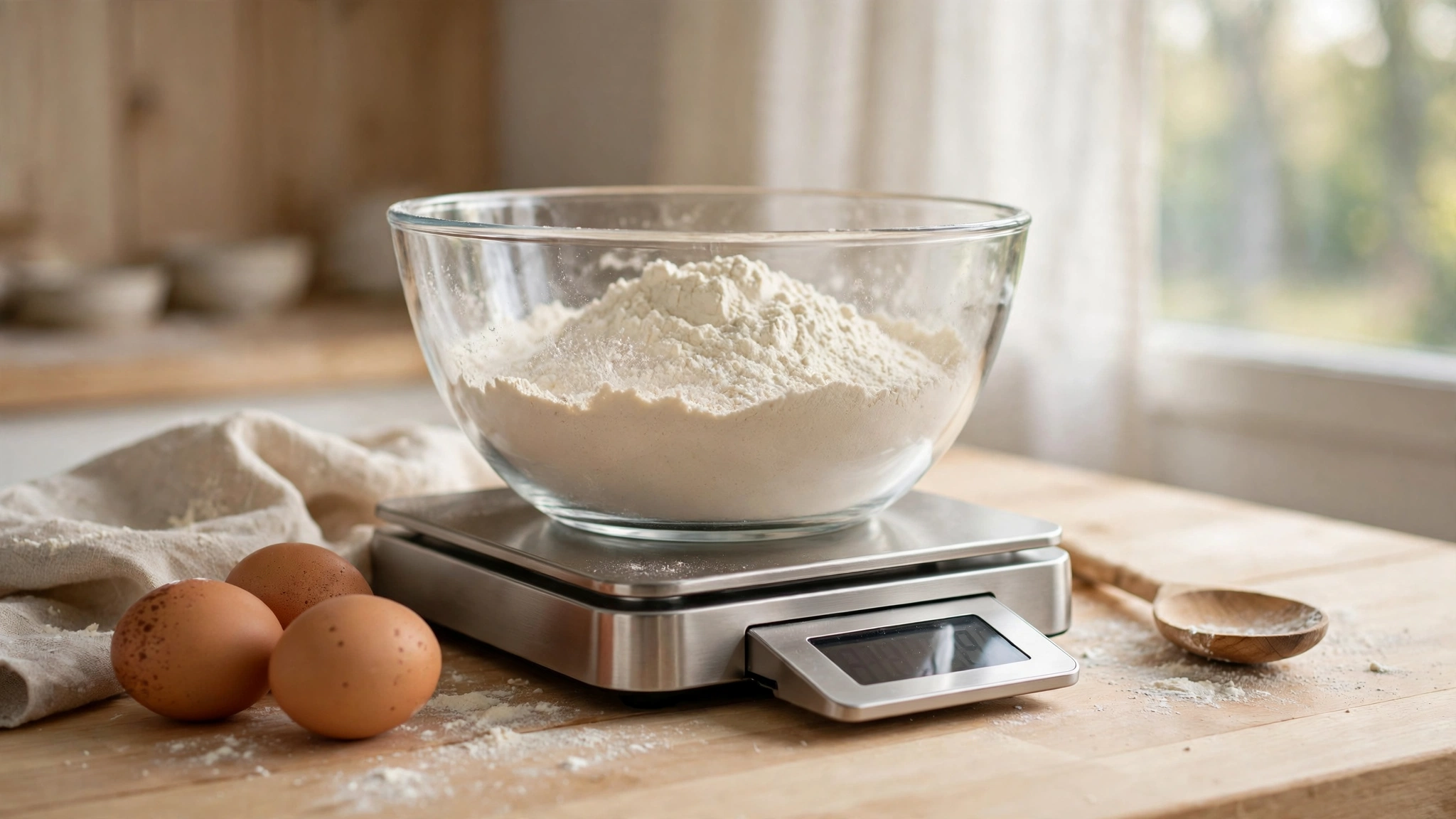
The cup is the problem, not your recipe
A cake that turns out perfect one week and dense the next is usually not a mystery. If you measured the flour with a cup, you probably used a different amount of flour each time without knowing it. A cup measures volume, and flour packs down differently depending on how you scoop it, how settled the bag is, and whether you level it off. Weighing the flour instead removes that whole variable. Two hundred grams is two hundred grams every time, no matter who is holding the scoop.
That is the whole case for a kitchen scale. It does not make you a better baker by itself, but it makes your recipes repeatable, which is the part most home bakers actually struggle with. Once the amounts are consistent, you can tell whether a change you made helped or hurt, instead of guessing.
Check capacity before you check anything else
Capacity is the first number to look at, because it decides what the scale can actually hold. An 11-pound capacity covers nearly everything in a home kitchen: a bowl of bread dough, a tray of portioned meat, a bag of produce, a pot you want to weigh in parts. If you regularly weigh a full stockpot or a large holiday roast, check that the pot plus the food stays under the limit, and remember the bowl counts toward the total.
The scale recommended below has an 11-pound capacity with a capacity indicator that shows how much room is left before the maximum is reached. That small meter is worth having, because a scale that silently maxes out just stops giving useful numbers.
Increments decide what the scale is good for
The second number is the smallest step the scale can read. For baking, 1-gram increments in metric mode are the practical standard: fine enough to weigh salt, yeast, and baking powder accurately, and the same scale reads in 1/8-ounce steps in US mode.
Do not buy an 11-pound kitchen scale expecting it to dose espresso. It reads to a gram, not a tenth of a gram, and that is a different tool for a different job. Match the increment to what you actually weigh, and the scale will feel precise instead of blunt.
The display has to stay readable under a big bowl
This is the detail people discover too late. A scale with a fixed display works fine with a small plate, and then a wide mixing bowl covers the numbers completely. You end up lifting the bowl to peek at the weight, which defeats the purpose.
A pull-out display solves it by sliding forward from the base, clear of the bowl, so the numbers stay visible while you pour. The scale below has that pull-out display, plus an optional backlight for dim kitchens. Before you buy any scale, picture your largest bowl on it and ask where the numbers would be.
Tare, units, and cleaning are the daily habits
The tare, or zero, button is the feature you will use every time. Put the empty bowl on the scale, press zero, and the display reads zero. Add flour, press zero again, and add sugar, and the display shows only the sugar. One bowl, no extra washing up, and every ingredient measured in the same place.
A unit conversion button that switches between ounces, pounds, grams, and kilograms keeps you from converting recipes by hand. And cleaning matters more than it sounds: flour dust gets everywhere, so a stainless steel platform that lifts off for hand washing stays usable, while a fixed top with seams around the buttons does not.
The one we would start with
If you want a single scale that covers baking, portioning, and everyday weighing, the OXO Good Grips 11-Pound Stainless Steel Food Scale with Pull-Out Display is a solid, well-established choice. The listing confirms the details that matter: 11-pound capacity, 1/8-ounce (US) and 1-gram (metric) increments, a pull-out display with optional backlight and a capacity indicator, a zero function for taring, unit conversion across ounces, pounds, grams, and kilograms, and a removable smudge-resistant stainless steel platform. It runs on four AAA batteries, which are included, measures 11.25 by 8.6 by 2.12 inches, and weighs 2.2 pounds. The trade-offs to know: it reads to a gram, not a tenth of a gram, so it is not an espresso scale, and in imperial mode it shows ounces in fractions, so grams are the easier unit for baking. Sold under ASIN B000WJMTNA. Amazon flags a newer version of this scale on the classic model's page, so if you want the latest revision, check the version selector on the listing before you buy.
See the OXO Good Grips 11-Pound Food Scale with Pull-Out Display on Amazon
As an Amazon Associate I earn from qualifying purchases. Prices and availability change, so check the current listing before you buy.
The short version
Weigh your flour, tare the bowl, and keep the display where you can see it. A scale with enough capacity, gram increments, and a pull-out display turns a recipe from a guess into a result you can repeat next week.