
Before You Buy a Dutch Oven, Lift One and Measure Your Shelf
A Dutch oven can last decades, but only if you buy the right size and can actually lift it. Check the weight, measure your shelf, and size it to the meals you cook most before you pick a color.
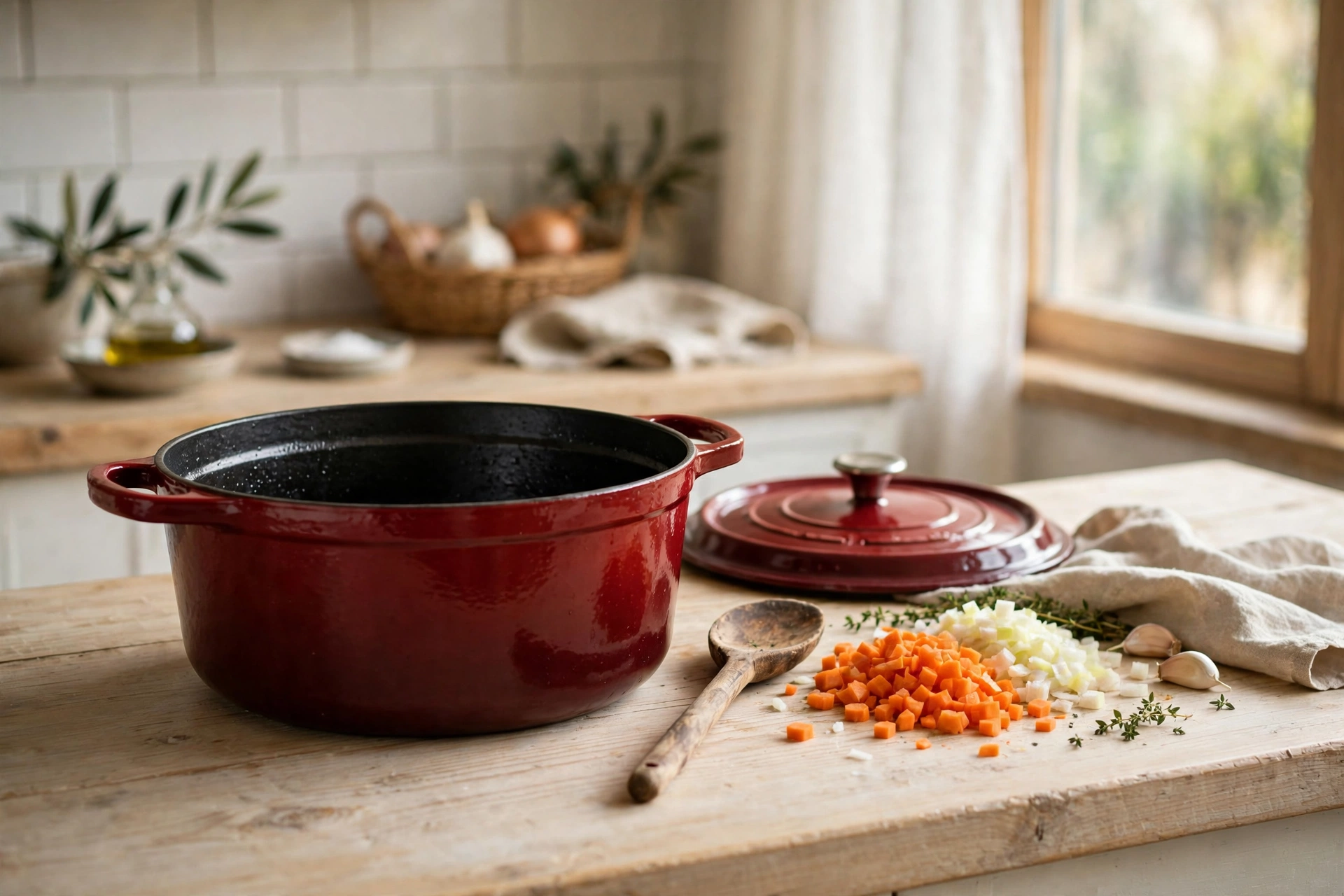
The pot is the easy part. The lifting, storing, and cleaning are the real decision.
A Dutch oven is one of the few kitchen purchases that can honestly last decades. It braises a pot roast, bakes a loaf of bread, simmers a pot of beans, and goes straight from the stove to the table. But it is also heavy, bulky, and unforgiving of a bad size choice. Before you fall for a color, do the three checks that actually determine whether you will reach for it every week or leave it stranded on a high shelf: lift it, measure your storage, and pick the size for the meals you cook most.
Start with size, and size it to your usual pot, not your biggest party
Most enameled Dutch ovens come in a spread of capacities, commonly 3, 3.6, 4.5, 6, and 7.5 quarts. The right one is the size that fits the meals you make on an ordinary Tuesday, not the holiday dinner you cook once a year.
- 3 to 3.6 quarts: good for one or two people, side dishes, and small batches of soup or grains. It is the easiest to lift and store.
- 4.5 quarts: a middle ground for small families and cooks who mostly make stews and braises for three or four.
- 6 quarts: the most versatile all-rounder. It holds a whole chicken, a big batch of chili, or a standard loaf of bread, and it still fits in a normal oven.
- 7.5 quarts: built for big-batch cooking and large families. It is the hardest to lift when full, so only choose it if you genuinely cook at that scale.
A pot that is too big is not just wasted space. A braise needs the liquid to come partway up the food; in an oversized pot, a small meal spreads thin, dries out, and cooks unevenly. A pot that is too small is worse, because it boils over. Buy for the meal you cook most often.
Lift it before you commit, because the number on the listing is only the empty weight
A 6-quart enameled cast iron Dutch oven weighs about 14.9 pounds empty. Add several pounds of food and liquid, and you are carrying close to 20 pounds of hot, heavy cookware with two small handles. That matters more than any feature list.
Before buying, ask yourself three honest questions. Can you lift it with oven mitts on, with one hand on each handle, and carry it from the oven to the table without straining? Can you get it in and out of your oven comfortably, including over the oven door? And can you wash it in your sink without wrestling it? If any answer is no, drop a size. A lighter pot you actually use beats a bigger one you avoid.
Check your shelf and your oven, not just your countertop
A 6-quart round Dutch oven is roughly 10.75 inches across and about 7 inches tall with the lid on. Measure the cabinet or shelf where it will live, including the height with the lid, and measure your oven's interior width. A pot that fits the oven but not the cabinet ends up living on the counter, where it collects dust and gets in the way. If space is tight, remember the lid can be stored separately, but the pot itself does not fold, stack, or shrink.
What enameled cast iron does, and what it does not
Enameled cast iron earns its reputation through heat retention. Once it is hot, it stays hot and cooks evenly, which is exactly what a slow braise or a loaf of bread needs. The porcelain enamel coating means it needs no seasoning, will not rust the way bare cast iron can, and handles acidic foods like tomato sauces without reacting with the metal.
It has limits worth knowing before you buy. Enameled ovens are oven-safe up to 500 degrees Fahrenheit, which covers nearly every braise and bread recipe, but the enamel can chip if the pot is knocked, dropped, or scraped with metal utensils. They are not made for outdoor grills, open outdoor flames, or microwaves. And while some listings describe them as dishwasher-safe, hand washing with warm, soapy water and a soft or nylon scrub brush is the care that keeps the enamel looking good the longest.
How to care for it so it lasts
- Hand wash it. Warm, soapy water and a nylon scrub brush are enough for most messes. Let stuck food soak rather than attacking it with steel wool.
- Use wood, silicone, or heat-safe nylon tools. Metal utensils can chip the enamel, and a chip is permanent.
- Heat it gradually. Warm the pot with the food or liquid in it rather than blasting an empty pot on high heat.
- Let it cool before washing. A very hot pot under cold water is hard on any enamel surface.
- Dry it fully before storing. The enamel will not rust, but the exposed rim and handles stay in better shape dry.
The one we would start with
If you cook for three or four people and want a single pot that covers braises, soups, stews, and bread, the 6-quart size is the right starting point, and the Lodge 6 Quart Enameled Cast Iron Dutch Oven is a solid, well-established choice. The listing confirms the details that matter: 6-quart (5.6-liter) capacity, enameled cast iron with no seasoning needed, dual handles, a lid included, and oven-safe use up to 500 degrees Fahrenheit, with a stainless steel lid knob rated to the same temperature. It works on gas, electric, ceramic, and induction cooktops, and it weighs about 14.9 pounds, so do the lift test in the store or be ready for the weight at home. The Island Spice Red colorway is the long-running version of this pot, sold under ASIN B000N501BK.
See the Lodge 6 Quart Enameled Cast Iron Dutch Oven in Island Spice Red on Amazon
As an Amazon Associate I earn from qualifying purchases. Prices and availability change, so check the current listing before you buy, and confirm the size and color selected on the product page match what you want.
The short version
Pick the size for your everyday meals, not your biggest dinner. Lift the weight before you buy it. Measure the shelf it will live on. Then choose the enamel color you like, because that is the part you will see every day, and it is the least important part of the decision.