Your Dog Drains the Water Bowl in Three Seconds
Your dog hits the water bowl like a finish line. A slow-feeder lick bowl puts a rolling ball in the mix and turns one big gulp into a few measured laps, for less floor mess and a calmer drink.
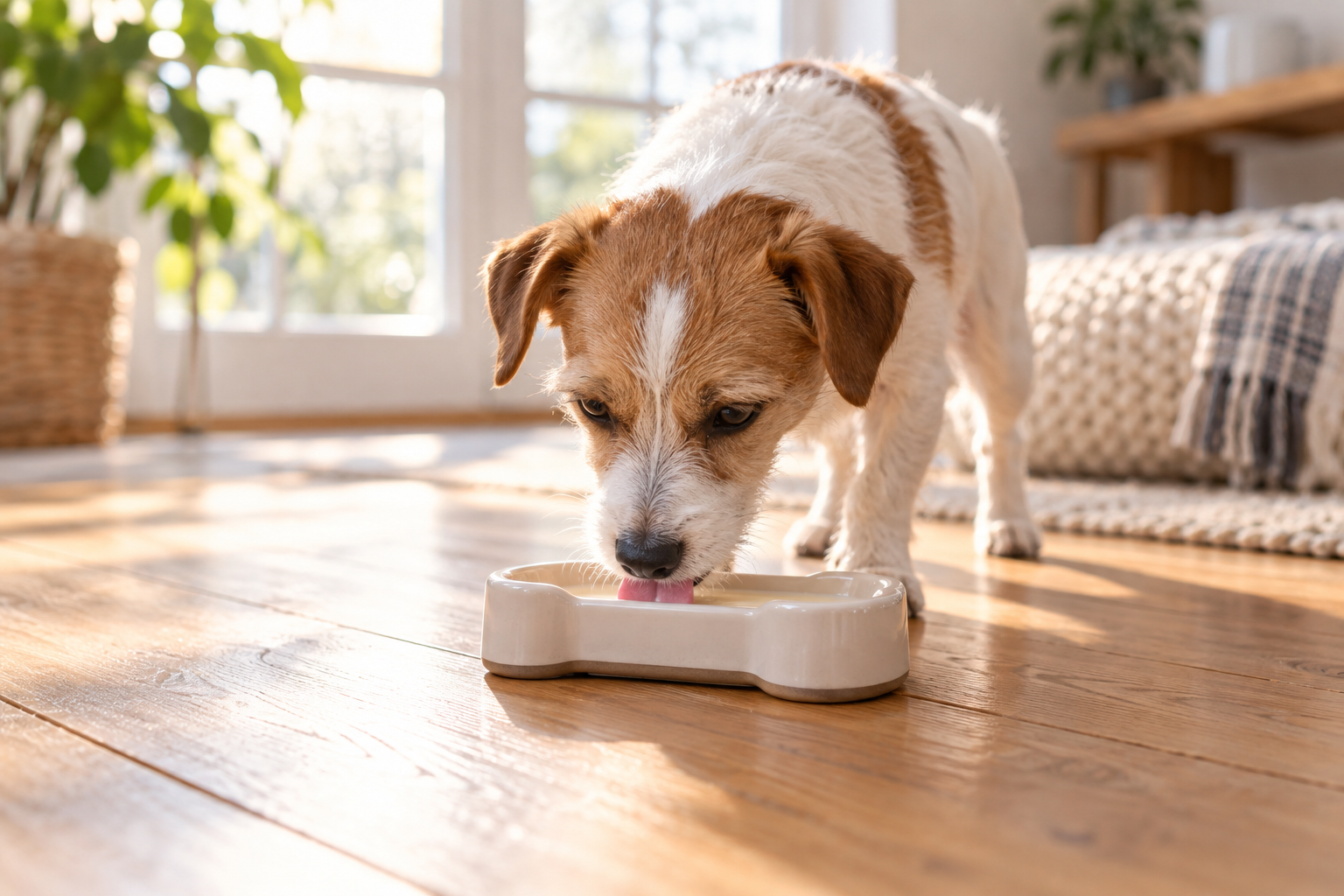
You just come through the front door, still holding the leash. Your dog has been waiting at the water station the whole time, and the second your hand is on the doorknob, the bowl starts gurgling. Three seconds later the dog has lapped up most of it, a few drops have landed on the tile, and now the dog is looking at you like you are the slow one.
If you have a fast drinker, that scene is not new to you. You probably also do the mental check that follows every big gulp: okay, that was fast. Was it fast enough to worry about? You do not want to become the person who measures the water bowl like a scientist, but you also do not want to miss a real signal.
Here is the honest version. Most of the time, gulping is just excitement plus a good sense of urgency. But drinking a lot, very fast, can push air into the stomach along with the water. That can mean gas, a bit of nausea, and the occasional dramatic burp. For big or deep-chested breeds, the same habit is worth a closer look, because swallowed air is one of the things that can contribute to bloat, the condition vets call GDV. A good plain-language overview of what fast drinking can do is worth a read, and the practical takeaway from it is simple: slow the pace, and the risk comes down with it.
There is also the reason the habit started in the first place, and it is worth knowing. Dogs are not doing this to be dramatic. They drink hard after a walk because their body is hot and the water was not there when they needed it. They drink hard in the morning because the night is long. And they drink hard after a meal because, in the wild, a drink after a chase and a catch is the whole reward. None of that logic is wrong. The bowl is just never the one that had to keep up.
The annoying part is the fix. You can keep topping the bowl up, and you can keep apologizing for the wet patch on the floor, but that is a habit, not the answer. What actually works is something that changes how the water is delivered, so the dog has to work for each sip instead of inhaling the whole thing in one go.
The bowl that slows the pace on purpose
There is a category of bowl built for exactly this, and the one I keep coming back to is the Yipetor slow feeder lick bowl on Amazon. It is a small, bone-shaped bowl, and the trick is the rolling ball that sits inside it. The ball moves with every lap, which does a few things at once. It keeps the liquid moving and aerated, so it stays fresher than a still dish. It turns drinking into a little game of reaching around the ball, which breaks the gulping rhythm. And it cuts down the splash, which is the real reason your floor stops getting a free bath every time the dog gets thirsty.
It also has a size that does real work. It holds about three quarters of a cup, which is small on purpose. A full-size bowl on a thirsty dog is an all-you-can-drink situation. A small bowl is a ration, and the dog has to come back for more. That one change does a lot of the work for you, because you do not have to be the one standing there rationing by hand.
It is worth a second on the maintenance side, because that is where these little gadgets usually lose. The ball comes out, the bowl is shallow, and there is not much hidden in the corners where a smell can set up. You rinse it after a broth or yogurt, which is the only real rule. Nothing to disassemble, nothing to dry in a drawer, nothing that quietly turns into a sponge.
- The rolling ball paces each drink and keeps the liquid moving.
- The no-spill shape keeps drips out of the corners of the room.
- The small capacity turns one big gulp into a few measured laps.
- The shape is simple to rinse, so it does not end up in the junk drawer.
Where it earns its keep
The honest pitch for a bowl like this is not the case that every dog needs one. If your dog sips politely and the floor stays dry, you are fine with what you have. The bowl earns its place in a few specific situations. A dog that drinks so fast it sometimes comes up a little. A senior dog that is doing better with small amounts of broth or liquid food than with a full bowl of kibble. A puppy that is still learning that the bowl is not a race. A dog recovering from a procedure that needs gentle nutrition on the side. And, full disclosure, the owner who just really is done with the wet spot on the tile.
It works for liquids more than solids. Bone broth, yogurt, thin soups, the kind of supplement you mix up for a picky eater. If your dog can manage kibble fine, the bowl is still a fine way to hand over something soft and a little more interesting than the usual bowl. The rolling ball is the whole point, and it only does its job when there is something liquid to move.
One thing I would not do is turn it into a behavior training device on day one. Introduce it as a treat bowl first, with something the dog genuinely likes, and let the ball become part of the routine before you ask it to pace the water. Dogs accept it far faster when the first few sessions feel like a bonus rather than a rule.
If your dog treats the water station like a finish line, you do not need a second dog to compete with. You need a bowl that makes every sip take a half second longer.
Setting it up so it actually gets used
There is almost no setup, which is one of the quiet wins here. You fill the bowl, you set it down, and the dog figures out the ball faster than you do. A few things make the first week smoother. Keep the bowl off a busy stretch of floor where a dog in a hurry is likely to barge through, because the pacing only works if the drink is calm. If the dog bounces off it at first, that is normal for the first day or two, and it usually settles once the novelty wears off. And if your dog is the type that will stand there and stare at you until you add more, do not feel bad about refilling a couple of times a day. That is the small capacity doing exactly what it is supposed to do.
When to check with the vet
A slow bowl is a help, not a diagnosis. If your dog is drinking a lot more than usual, or the gulping is new, or there is vomiting, a swollen belly, or a general low energy, that is a vet conversation rather than a bowl problem. The tool handles the pace. It does not replace the check-up.
Frequently asked questions
Is a lick bowl the same as a slow feeder? Not quite. A slow feeder is a bowl with a maze that slows down kibble. A lick bowl is built for liquid, and the slowing comes from the ball and the small size instead of a pattern. If your dog is a problem with dry food, the maze bowl is the one to get. If it is the water and the broth, this is the one.
Will it stop my dog from getting bloat? It helps, because it reduces the air that goes down with a fast drink. But bloat has more causes than one habit, and a bowl is not a guarantee. If your dog is a big or deep-chested breed, keep the vet loop open either way.
Can I use it for treats and supplements? Yes, that is one of the better uses. A measured amount of liquid supplement in a bowl that paces the drink is easier to hand over than chasing the dog with a syringe, and the dog is less likely to reject it if it is something the dog has to work for a second.
You can find the Yipetor slow feeder lick bowl on Amazon for about twenty dollars, which is about the price of the floor mat you keep re-laying after every big gulp. If your dog finishes a full bowl in the time it takes you to hang up a leash, this is the kind of small thing that fixes the pace without changing anything else about the day.