Five Bands, One Drawer: The Resistance Set That Makes Home Workouts Happen
Five loops, one drawer, fifteen minutes. A loop resistance band set is the smallest honest home gym, and this guide covers what to check before you buy, a starter routine, and the one set we would hand a friend.
Most home gyms fail the same way. Not from lack of effort, but from friction. The equipment lives in a spare room, or the garage, or behind three other boxes, and by the time you have cleared a space, you have talked yourself out of the workout. The gear that actually gets used is the gear that lives where you already are: within reach, with nothing to assemble and nothing to plug in.
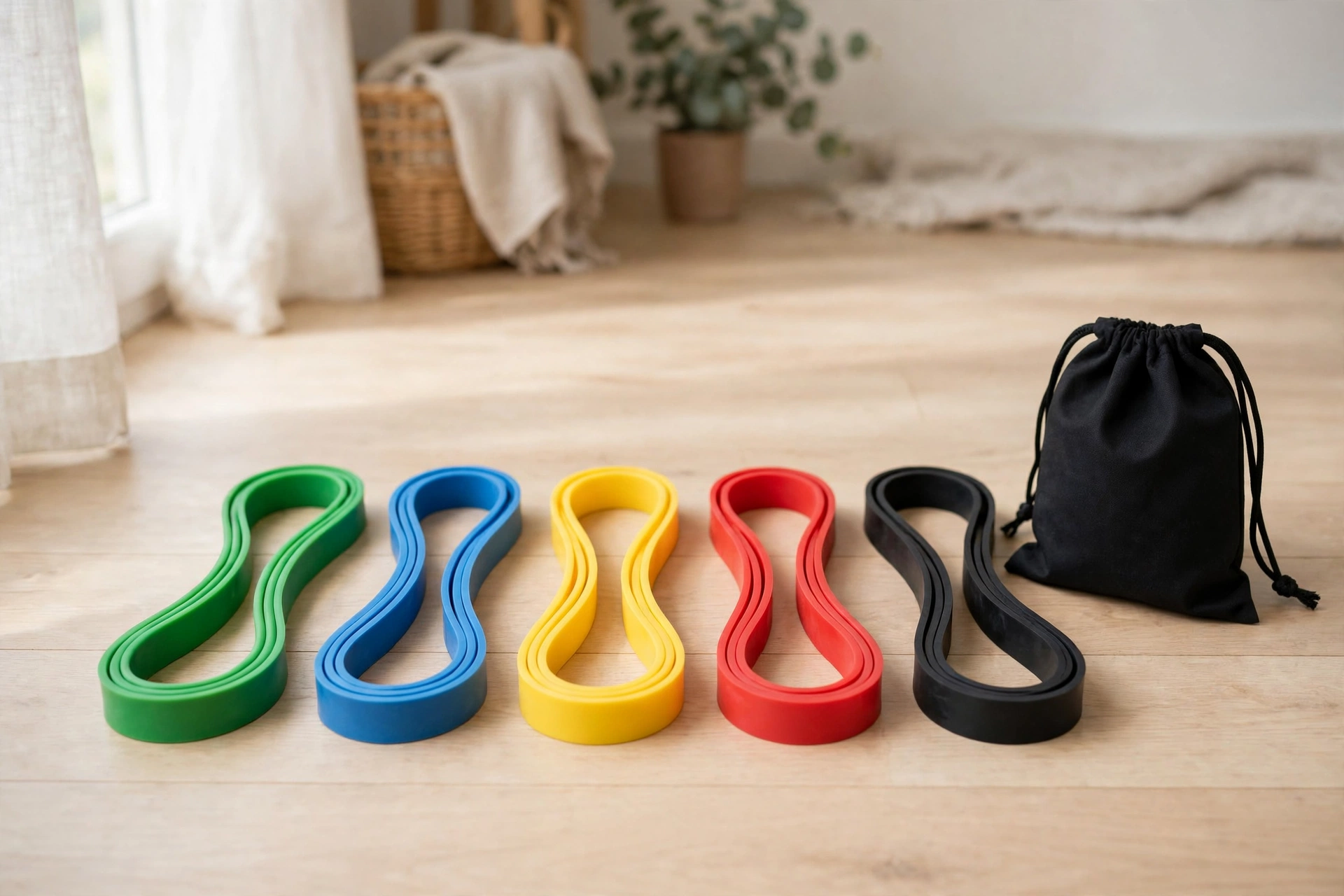
A set of loop resistance bands is the smallest honest version of that idea. Five stretchy loops, a pouch the size of a sandwich bag, and a drawer. That is the whole gym, and it is enough for the workouts most people actually do at home: glutes, hips, shoulders, arms, and the warmup work that keeps knees and backs happy.
This guide covers what to check before you buy a set, a fifteen minute routine to start with, and the one set we would point a friend toward, with the tradeoffs stated plainly.
Loop bands or tube bands: pick the shape that matches your workout
Two shapes dominate the market, and they are not interchangeable. Loop bands are closed circles, about 12 inches long when laid flat, and they shine at lower body work: lateral walks, clamshells, glute bridges, and hip activation. Tube bands have handles and often a door anchor, and they suit pressing and pulling for the upper body. If you can only buy one set, buy the shape that matches the exercises you will actually do. For most home workouts, that is the loop.
What to check before you buy
Resistance range. A useful set spans at least five levels, from extra light to extra heavy, so you can start easy and progress without buying a second set. Check that the levels are color coded, so you are not guessing mid workout which band is which.
Material. Most loop bands are natural latex, which stretches smoothly and holds its resistance over many reps. Latex is the catch for anyone with a latex allergy, so check the material line before ordering. Fabric bands exist for that case. They grip better and roll less, but they cost more and stretch less.
Size. Standard loops measure about 12 inches long by 2 inches wide when laid flat. That size fits most adults for hip and leg work. Shorter mini bands can feel tight on larger frames, and longer 41 inch bands are a different tool, meant for pull up assistance.
Extras that matter. A carry bag and an instruction guide are the two extras worth having. The bag is what keeps five loose bands from becoming a tangled drawer, and the guide matters because most people buy bands, try two exercises, and stall. A booklet with illustrated moves is the difference between a set that gets used and a set that gets forgotten.
A fifteen minute starter routine
Do this three times a week. Two sets of each move, slow and controlled, with thirty seconds of rest between sets.
- Glute bridge, band above the knees: 12 reps. Press your knees out against the band as you lift your hips.
- Lateral walk, band above the knees: 10 steps in each direction. Stay low, keep tension on the band, and do not let your feet touch.
- Clamshell, band above the knees: 12 reps per side. Lie on your side, knees bent, and open the top knee like a book.
- Seated row, band around your feet: 12 reps. Sit with your legs straight, hold both ends, and pull your elbows back.
- Bicep curl, standing on the band: 12 reps per arm. Keep your elbow still and curl slowly.
Start with the lightest band that still makes the last two reps feel hard. When every rep feels easy for two sessions in a row, move up one color.
The honest downsides
Three things worth knowing before you buy. First, thin latex loops can roll up on bare skin during leg work, which pinches and interrupts the set. Leggings or long socks under the band fix most of it. Second, latex degrades in heat and sunlight, so a set left in a hot car will not last. Third, bands are not a replacement for heavy barbell training. They are a complement, and they top out well below what a loaded barbell offers. If your goal is a heavy deadlift, buy a gym membership, not a band set.
How to make a set last
Rinse the bands with mild soap and water after sweaty sessions, dry them flat, and store them out of direct sunlight. Before each workout, give every band a quick stretch and look for nicks or thin spots. A band with a nick is a band that will snap, so retire it. If one band in a set goes, replace the set rather than mixing old and new bands with different stretch.
The set we would buy
If you want one set and no research project, this is the one we would hand to a friend starting out.
Fit Simplify Resistance Loop Exercise Bands, Set of 5
Five color coded latex loops, extra light to extra heavy (about 5 to 35 pounds of resistance), 12 by 2 inches, with a carry bag and an illustrated instruction guide.
Rated 4.5 out of 5 stars from more than 135,000 Amazon ratings, and ranked number 1 in Resistance Bands on Amazon.
See the current price on Amazon: Fit Simplify Resistance Loop Exercise Bands, Set of 5
As an Amazon Associate I earn from qualifying purchases.
Why this one: five color coded levels from extra light to extra heavy, listed at about 5 to 35 pounds of resistance, in the standard 12 by 2 inch loop size, made from natural latex, with the carry bag and the illustrated guide included. It is rated 4.5 out of 5 stars from more than 135,000 Amazon ratings, and it holds the number 1 spot in Amazon's Resistance Bands category. The two recurring complaints in reviews are the ones this guide already warned you about: the bands can roll on bare skin, and latex is not for everyone. Skip this set if you have a latex allergy, and look at a fabric loop set instead.
The bottom line
A home workout habit is built on low friction, not on heavy equipment. Five loops in a drawer, a fifteen minute routine, and a set you can carry in a jacket pocket will do more for your consistency than a machine you have to make room for. Buy the set, learn the five moves, and let the routine do the work.